


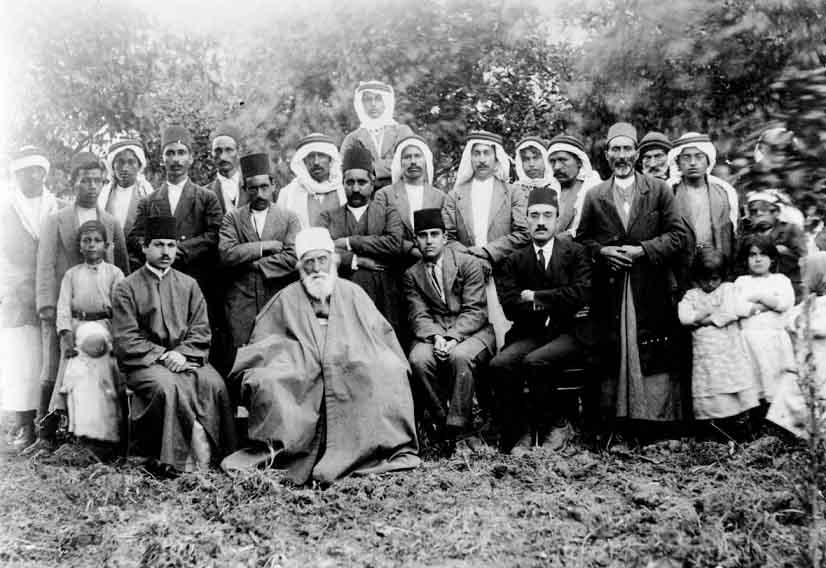
The story begins when the security apparatus of the Ottoman government became suspicious of ʻAbdu’l-Bahá (ʻAbbás Effendi) and began monitoring his activities. ʻAbdu’l-Bahá, the son of Bahá’u’lláh (the founder of the Bahá’í Faith), played a crucial role in the development of the Bahá’í community. One of his significant actions involved the purchase and acquisition of Arab lands in Palestine and transferring them to Jewish immigrants. According to a report from the final years of Bahá’u’lláh’s life, as narrated by Seyyed Maqdad Nabavi from the book of Sheikh Mahdi Sheikh al-Mamalik Qomi, the story is described as follows:
“…In summary, ʻAbbás, with careful management, limited and restricted the authority of Mirza Muhammad Ali, preventing him from taking any action. When Mirza Muhammad Ali realized that he could achieve nothing through religion, he resorted to political measures and portrayed ʻAbbás as culpable before the Ottoman government. He claimed that ʻAbbás intended to rebel and had gathered a group around himself; he was constructing fortifications, and that the site on Mount Carmel being developed as the tomb of the Báb was, in fact, a fortress, as a tomb does not require such facilities. The government, in its caution, first prohibited construction and then forbade ʻAbbás from leaving the city, and up to now, as of 1 Rabi‘ al-Awwal 1324 AH, ʻAbbás has not been fully exonerated… It is said that once the Ottoman government became suspicious of ʻAbbás, it intended to execute him; however, an incident [an attempt on the Sultan’s life in Istanbul] occupied the Sultan’s attention, preventing this action.” [1]
This report indicates that ʻAbdu’l-Bahá engaged in suspicious activities in the Acre and Haifa regions and maintained complex relations with Jewish immigrants to Palestine and the British monarchy. [2]
Ottoman Account of ʻAbbás Effendi’s Cooperation with Jews (1329 AH / 1309 AH)
A report sent to Istanbul in 1309 AH claimed that ʻAbbás Effendi, together with two Ottoman officials in Palestine, purchased the lands of impoverished Arabs at low prices and resold them at high prices to Jewish immigrants. [3] This report concerned Jews exiled from countries such as Russia and Romania who had illegally settled in the areas of Jaffa and Haifa in Palestine, as well as those who facilitated their settlement and how the Jews reacted to their opponents. [4]
The report reads as follows:
Our sincere and humble report to the august presence of the Sublime Caliphate
We, servants of generations past, nurtured by the abundant favors of the everlasting Ottoman government and guided by conscience and innate disposition, as well as religious and patriotic zeal, feel compelled to report any movement contrary to the will of His Majesty the Sultan throughout the domains of the realm. These servants, originally from Balqa, Beirut, and Haifa, while serving in the districts of Acre and Balqa, observed in the Haifa district, subordinate to the Sanjak of Acre, acts that were entirely contrary to the noble principles and the favor of His Sublime Majesty, as follows:
Despite the prohibition by His Majesty the Sultan against the settlement and permanent land ownership of foreign Jews, particularly in Palestine, in the past year some individuals, by concealing their interests and ulterior motives, including Mustafa Effendi (former deputy of Haifa), Ahmad Shukri, Ali (Mufti of Acre), Mustafa (head of Haifa municipality), and Najib Effendi (member of the local council), mediated by two Jews named Moses Hanker and Mayer Zablon (subjects of Russia and associates of Baron Hirsch) residing in Jaffa and Haifa villages, brought one hundred and forty Jewish families, officially exiled from Russia, to Haifa during the tenure of Sadiq Pasha (Sanjak-Bey of Acre) and settled them there. Former Governor of Adana, Shakir Pasha, and Selim Nasrallah al-Khuri (from Mount Lebanon) participated in this process. [11]
Shakir Pasha and Selim Nasrallah, who owned lands known as “Hadhira,” “Dardara,” and “Nafi‘at,” previously purchased 1,800 plots in hundreds, sold them to the aforementioned Jews for eighteen thousand lira. Moreover, after agreeing on an additional two thousand lira for the officials involved, the Jewish families were transported by ship from the country, while the Jews were dispersed throughout the district.
In addition, Mustafa Effendi, acting beyond his authority, forged old-date permissions, rebuilt one hundred and forty houses on these lands, established villages, settled Jews, levied taxes before any produce was harvested, and counted them as residents of the Sultanate. Furthermore, based on a secret contract involving the payment of one Majidiya from each wealthy person, all transactions were completed in one day, and Ottoman registration documents were issued. Foreign Jews who had entered the Ottoman domains illegally were naturalized in a single day, with the consent of local officials. The Mufti of Acre, Ali Effendi, representing Ali Pasha, and Selim Nasrallah al-Khuri of Mount Lebanon, having received eighteen thousand lira for the lands, ignored the interests of the local population, and the activities of expelled Jews were evident in Haifa and Acre.
Investigations were conducted in Acre, Haifa, Nablus, and Jerusalem to verify these reports, and it was confirmed that every ship arriving in Haifa played a role in transporting and settling Jews. The original owner of the village now called “Zamarin,” under the protection of Baron Rothschild, had died without heirs; the village was sold to Jews, and three neighboring villages—“Ashfiya,” “Umm al-Tut,” and “Umm al-Jamal”—were subsequently incorporated. A ruined plot worth a few thousand groschen was also purchased from Sadiq Pasha for two thousand lira. In the area between Haifa and Jaffa, in Bahriye Shoutouti, over thirty thousand plots known as “Hishmoz Zarqa” were sold at one lira per plot. Further lands from Mount Carmel were sold to French monks and, following German and British competition, portions were acquired at low prices and developed with churches and structures.
Consequently, these irregularities were intolerable. Under the Sanjak-Bey Zewur Pasha of Acre, legal measures were taken to reclaim these lands; however, a subsequent order halted all proceedings. Over time, lands were used by foreigners, and ʻAbbás Effendi of Iran, with significant wealth and influence in Acre, collaborated with Mustafa (head of Haifa municipality) and Najib Effendi (current council member) to purchase lands from the powerless at very low prices and resell them to Jews and foreigners at exorbitant rates.
Furthermore, Jews’ financial contributions, under the guise of generosity, were sanctioned by local officials, and the local Muslim villagers suffered severe injustices and abuses, including attacks on women. Reports indicate that in Zamarin, Jews forged coins, assaulted local officials, and freely exercised authority, teaching skills and sciences in newly established schools.
Therefore, in order to document and prevent these deplorable conditions, we present this report with the utmost humility and sincerity, subject to the order of the rightful authority.
3 August 1309 AH / 15 August 1893 CE
Reporters:
- From Beirut, Balqa: former manager of Sharawieh al-Sharqi district and Nadd officer: Subhi.
- From Haifa, Sanjak Balqa: former Regie manager: Muhammad Sa‘id.
- From Nablus, former deputy of Acre public prosecutor: Sayyid Muhammad Tawfiq.
As seen, this report dates to 1309 AH (1893 CE), the year Bahá’u’lláh passed away. [19] ʻAbbás Effendi assumed leadership of the Bahá’ís thereafter; thus, if the report is accepted as accurate, he had been interacting with Jewish immigrants in Palestine from the final years of Bahá’u’lláh’s life.
References:
- See Chapter 22, “On the Death of Bahá’u’lláh and Subsequent Events.”
- Excerpted from From Shiraz to Acre: Post-Scripts on Sheikh Ahmad Shahrudi’s Views on Bábís and Bahá’ís, unpublished; translation by Mohammad Hossein Sadeghi under supervision of Dr. Ali Kalirad.
- Osmanlı Belgelerinde Filistin (Palestine in Ottoman Documents), Prime Ministry Ottoman Archive, Istanbul.
- Glossary of Ottoman administrative terms: Sanjak, Qadaa, Qa’im Maqam, Majidiya, Lira, Groschen.
- Shams al-Din Sami, Al-Mu‘jam al-Turki al-Turathi, vol. 2, pp. 964, 1073.